|
PRICES
PEOPLE
APPRENTICE SERVICES
PARTNERSHIPS
PIANO CARE
CUSTOMERS
REVIEWS
CONTACT
SCHEDULE AN
APPOINTMENT
PIANO SHOP


 |
|
PIANO CARE
This general overview provides a single reference source for most questions you might have
about the care of your piano. Pianos are generally made of wood, metal, leather, and felt. Each
of these elements is affected by changes in the environment as well as the presence of dust or
chemicals. This overview will explain both what is improper and what is ideal. I'll talk about
the role of professional maintenance, humidity and temperature control, cleaning, and preventative
care. You should be able to consult this text to understand how to treat your piano, and to understand
what the dangers of neglecting it can be. |
|
|
 |
|
REGULAR MAINTENANCE
Keeping in touch with your piano technician, and scheduling regular maintenance are important.
Through the course of a year, your piano will be affected by many factors, and
will require the care of a professional technician to mitigate the negative effects of
these changes. Since changes in humidity will probably affect your piano's tuning the most, it is
recommended that you schedule a tuning to follow the major seasonal shifts, at a time when the
instrument's environment has stabilized.
IDEAL
I recommend to have your piano tuned twice a year. The Chicago and New York areas both experience
drastic changes in humidity and temperature throughout the year, but your piano is also affected
by home heating and air conditioning systems. It is a good idea to call your piano technician several weeks after
you have had your heating system turned on, once a dryer
environment has been established, and also to call your technician several weeks after your heating
system is off. In Chicago and New York, ideal times
might be around May and November, depending on the climate changes. Tuning a well maintained, and
regularly tuned piano should require very minor adjustments in pitch, which in turn means that
the state of the piano will not have to be altered much at all. Consequently, stability is maintained,
and your piano is preserved. As a bonus, regular tuning gives your piano technician a chance to
apprise you of and regulate minor technical problems in the action*, before they get out of hand.
Schedule a major regulation of your action every few years as well. In a regulation, the
technician will lubricate and realign the action parts so that they are working smoothly and efficiently.
*a piano's "action" refers to the moving parts inside your piano that result in a note being played.
IMPROPER
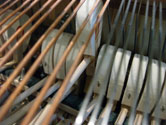
If your piano has not been tuned for several years, it has been allowed to drift further and further away
from the state it was designed to be in. Most often, the piano will require a pitch raise, in addition to
the tuning. This means that the piano must endure a more extreme change than it ought. This necessary
change, compounded with the preceding shifts it is designed to counteract, all contribute to the aging
and deterioration of your piano. In addition, in the absence of regulation, interior components of your
piano will have shifted and settled into less than ideal patterns of use, encouraging wear and tear in
an inconsistent way from note to note. Pianos that have not been visited by a technician for years tend
to be dusty, and dried out on the inside, and have become very difficult to regulate properly. |
|
 |
|
HUMIDITY
One of the most detrimental threats to your piano's stability can be the annual, or even daily
changes in humidity that shift most extremely when you begin to, or cease to use a heating system
in your home. The soundboard, a 3/8 inch thick sheet of wood, sits opposite your strings and is
connected to them by a piece of wood called the bridge. As humidity increases, the soundboard
expands, increasing string tension, and pushing the piano strings sharp. As humidity decreases,
the opposite occurs, making the piano flat. Humidity will also affect other wood and felt parts
of your instrument.
IDEAL
An ideal level of relative humidity (RH) is about 42%. Relative humidity is a measure of the air's
tendency to absorb or release moisture to its surroundings. When RH is low, the air steals moisture
from the parts of your instrument. When RH is high the air transfers excess moisture to those same
parts. RH varies with respect to the temperature, and moisture content of the air, so it's not always
simple to regulate. The most efficient way to stabilize humidity levels for your instrument is to
install a humidity control system in the piano. This will sense RH levels, and humidify, or dehumidify
as needed to maintain consistency with respect to humidity.
IMPROPER
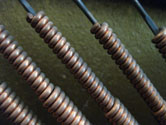
As extreme shifts in humidity occur, the tuning of the piano becomes incorrect and the piano stabilizes
in an out of tune state. In high humidity, some parts in the action may expand, causing points of friction
to be sluggish. A common cause of sticky keys, is an expansion of felt bushings, due to increased humidity.
If your piano gets overly damp in some area, it can even start to mildew. Extreme dryness, on the other
hand, especially after extreme humidity, can cause wood parts, such as the soundboard, to become prone to
cracks, which compromise the sound quality, and value of your piano. |
|
 |
|
TEMPERATURE
As mentioned before, temperature is a factor which affects relative humidity, which in turn
affects many parts of the piano. Direct sunlight or exposure to direct streams of cold or hot air
are common issues which cause shifts in temperature.
IDEAL
I've encountered recommended ideal room temperatures as high as 74-78 ºF and as low as 65-70 ºF.
Whatever temperature you like, just keep it consistent. Extreme temperature fluctuations are what
you want to avoid. Ideally, your piano is placed near inside walls, away from windows, doors or
other sources of hot, or cold air. If the sun shines through a nearby window, blinds or curtains
are implemented to mitigate the possibility that the piano is exposed directly to sunlight on a regular basis.
IMPROPER
There are all sorts of less than ideal places a piano can be unwittingly placed, and inadvertently
exposed to extreme shifts in temperature. Try keep your instrument away from heating or air conditioning
vents, doors, windows, poorly insulated outside walls, and fireplaces. Definitely avoid garages or
porches! Avoid direct sunlight on your instrument. A piano may look great in the sunlight of the
front window, but be careful. Regular exposure to direct sunlight can not only heat your piano's
insides, but cause unattractive fading of your piano's finish. |
|
 |
|
CLEANING AND PREVENTION
If you are reading this, chances are that you care for your piano and you want it to look,
as well as sound good. You probably want to avoid dust, debris, and dirt inside and out. That's
commendable! A clean piano is usually a sign of an owner who values and enjoys their instrument
to the fullest extent. Fortunately, your job is pretty simple in the area of cleaning.
IDEAL
Keep your piano's lid and key cover closed when the instrument is not in use. Dust with a feather duster
regularly. Polish with a piano cloth or with a soft damp cloth followed by a dry one, following the grain
in the case of a wood finished piano. When scheduling a tuning, or maintenance, you can request ahead of
time that your technician make sure that the parts that you can't get to are clean and well maintained.
This may include the action, soundboard, key bed (area under the keys), and other inaccessible interior areas.
IMPROPER
It's risky to keep things that might spill, such as drinks, vases, or plants on your piano. On the
outside, liquid can cause a stain on your finish. On the inside, liquid can cause irreversible damage
to action parts. Try not to leave the key cover, and lid of the piano open when it is not in use. Dust
will collect inside of the piano, encouraging dryness, and introducing particles into the action,
which can accumulate and cause sluggishness in the action's components. Furniture polish, and household
cleaning agents are not recommended in cleaning any part of the piano. Polishes are generally not
beneficial, and cleaning agents contain chemicals which can damage the finish, and corrode action
parts and strings, or adulterate the glue that affixes parts, such as the tops of keys. |
|
  |
 SCHEDULE AN APPOINTMENT
