 SCHEDULE AN APPOINTMENT SCHEDULE AN APPOINTMENT |
||||
 |
 |
|||
|
PRICES |
PRICES |
|||||
MARIA CAPUTO - (New York)
|
LUIS CRUZ- (New York)
|
|||||
|
Tuning - $100 |
Tuning - $100 |
|||||
JEROME ELLIS - (New York)
|
STEVE MAX - (New York)
|
|||||
|
Tuning - $105 |
Tuning - $125 |
|||||
BIMOL KARMAKER - (New York)
|
DANIEL DIMAGGIO - (New York)
|
|||||
|
Tuning - $155 |
Tuning - $165 |
|||||
EATHAN JANNEY - (New York)
|
NEWAY LAU - (Hong Kong)
|
|||||
|
Tuning - $195 |
Tuning - 350 HKD |
|||||


DEFINITIONS |
||||||
 |
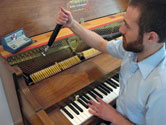
TUNINGPiano tuning involves two major activities. One is determining the fundamental frequency with which each note on a piano ought to vibrate so as to be perceived as pleasing in the context of the other notes of the instrument. The second is the adjustment of each string so each will ring at its desired frequency. The adjustment is achieved by turning tuning pins which the strings wrap around and making sure the strings and pins are stabilized in the proper position. The pins sit snugly in a block of maple and are turned using a special tool called a tuning hammer or tuning wrench. Turning a tuning pin changes the tension of the string which changes the frequency at which the string vibrates. A piano that is in tune sounds richer and fuller. This is because the strings are vibrating at frequencies that interact in a way that is pleasing to the ear. There are several signs that a tuning is needed. One, a note may sound out of tune when played alone. Two, intervals or chords may sound bad when notes are played together. Three, a piano may sound adequately "in tune with itself" yet be flat or sharp from standard pitch. In this A tuning every six months is recommended to ensure a home piano is relatively in tune all year round. return to top |
|||||
 |
PITCH RAISEA pitch raise is a rough tuning, which generally takes less than a half an hour. We call it a pitch raise because one must raise the pitch of each string about 25 to 30 percent as sharp beyond concert pitch as it was flat. By the time the pitch raise process is completed, the strings have fallen back to approximately concert pitch and a fine tuning can successfully be achieved. A pitch raise or pitch adjustment is needed when, in order to achieve the desired tuning, a great shift in tension across all the strings of the piano is required. All of the strings of the piano are exerting pressure on a large piece of If the instrument is tuned regularly (about every six months) it may never require a pitch raise. If it has been a long time you should expect that one will be needed. We will let you know ahead of time if we conclude that one will be necessary. return to top |
|||||
 |
REPAIRSRepairs, which are different from regulation, are less common and usually involve some glue, |
|||||
 |
REGULATIONA full regulation is a step by step procedure and can take many hours. It involves ensuring that every action mechanism that can be adjusted is in the ideal alignment. Since the parts of the piano work as a system of interdependent mechanisms, adjustment of one part will affect the others. A formal, step by step process of regulation ensures that the adjustment of one function to its proper alignment is not affecting the capacity of another function. If regulation is needed, one will notice that the action doesn't "feel right," or respond well when playing. In more obvious cases, a key or two may not function. The key may stick, or the hammer might double strike the string, or you might press down the key and the note does not sound. Many sources recommend a full regulation every four years or so. Minor regulation procedures may be sufficient to address a minor problem these may be necessary from season to season as humidity affects the action. return to top |
|||||
  |
||||||